
Thailand
Explore Thailand: A Complete Travel Guide
Thailand combines glittering temples, legendary street food, jungle-covered mountains and some of the most beautiful islands in Asia. Bangkok is a hectic, fascinating capital, Chiang Mai is the cultural heart of the north, and the coasts of the Andaman Sea and the Gulf of Thailand offer limestone cliffs, white beaches and warm water. Good infrastructure and friendly people make it an easy country for first-time visitors to Asia, yet it still rewards travellers who go beyond the obvious stops. This guide covers when to go, the 2026 entry rules, getting around, costs, food, the best places to visit and where to stay.
Thailand travel guide: the essentials
- Capital: Bangkok.
- Currency: Thai baht (THB). Cards are accepted in hotels, malls and many restaurants; carry cash for markets, street food and small shops.
- Language: Thai. English is widely spoken in tourist areas.
- Entry: many nationalities can stay up to 30 days visa-free, and every visitor must complete the free Thailand Digital Arrival Card (see below).
- Driving: on the left.
- Best for: temples, street food, island hopping, diving, jungle trekking, nightlife and wellness.

Contents
- Best time to visit Thailand
- Visas and entry rules
- Getting around Thailand
- Travel costs in 2026
- Safety and local laws
- Culture, etiquette and festivals
- Top places to visit
- Islands and regions
- Thai food
- Where to stay
- Itinerary ideas
- Practical tips
Best time to visit Thailand
Thailand has three seasons, but the timing differs between the two coasts:
- Cool and dry season (November to February): the best time for Bangkok, Chiang Mai and the north, with lower humidity and pleasant evenings. It is also high season, so book ahead.
- Hot season (March to May): temperatures often reach 35 to 40 °C. April is the hottest month, but also the time of the Songkran water festival. In the north, smoke from agricultural burning can affect air quality in March and April.
- Rainy season (June to October): short, heavy showers rather than all-day rain in most places, with green landscapes and lower prices.
- Andaman coast (Phuket, Krabi, Koh Lanta, Phi Phi): best from November to April. From May to October the sea is rougher and some boat trips stop.
- Gulf of Thailand (Koh Samui, Koh Phangan, Koh Tao): the main rains fall from October to December, so January to August is a good alternative when the Andaman side is wet.
Visas and entry rules
Thailand changed its entry rules in 2026, so check them before you book:
- Visa exemption: since 15 September 2026, passport holders from 60 countries and territories, including the United States, the United Kingdom, Canada, Australia and many European countries, can stay up to 30 days without a visa. The previous 60-day exemption has been abolished. For longer stays you need a visa in advance.
- Thailand Digital Arrival Card (TDAC): every foreign visitor must fill in this free online form within the three days before arrival, on the official immigration website. You receive a QR code to show at immigration. Ignore sites that charge a fee for it.
- Tourist entry fee: a fee for foreign visitors has been discussed for several years (most recently between 300 and 450 baht), but it was not yet being collected at the time of writing in November 2026.
Your passport should be valid for at least six months, and immigration may ask for proof of onward travel.
Getting around Thailand
Domestic flights
Low-cost airlines such as Thai AirAsia, Thai Lion Air and Nok Air, plus Bangkok Airways and Thai Airways, connect Bangkok with Chiang Mai, Phuket, Krabi, Koh Samui and many other cities. Flights of one to two hours are often cheaper than you would expect. Note that Bangkok has two airports: Suvarnabhumi (BKK) for most international and full-service flights and Don Mueang (DMK) for many low-cost carriers.
Trains and buses
The overnight sleeper train between Bangkok and Chiang Mai is a classic experience, taking roughly 11 to 13 hours. Comfortable long-distance buses cover almost every route. In Bangkok, the BTS Skytrain and MRT metro are the fastest way to avoid traffic, and the Chao Phraya Express Boat is a cheap way to reach the riverside temples.
Taxis, tuk-tuks and ferries
Ride-hailing apps such as Grab and Bolt are widely used and avoid haggling over fares. Tuk-tuks are fun for short rides, but agree on the price first. Ferries and speedboats link the islands; book with a reputable operator and check the weather in the rainy season.
Travel costs in 2026
Thailand offers excellent value, although Phuket, Koh Samui and Bangkok’s luxury hotels can be expensive. Some reference prices:
- Grand Palace and Wat Phra Kaew, Bangkok: 500 baht for foreign visitors, including the Queen Sirikit Museum of Textiles.
- Other temples: Wat Pho and Wat Arun charge a few hundred baht or less; many temples are free.
- Street food: a plate of noodles or rice from around 60 to 120 baht.
- Accommodation: hostel dorms from about 300 baht, comfortable mid-range hotels from around 1,500 to 3,000 baht per night.
- Massage: a one-hour traditional Thai massage typically costs a few hundred baht outside luxury spas.
Thailand received just under 33 million international visitors in 2025, about 7% fewer than in 2024, so outside the peak weeks around Christmas and New Year you will often find good deals.

Safety and local laws
- Scams: be wary of anyone telling you that the Grand Palace or a temple is “closed today” and offering a tuk-tuk tour instead; this usually ends at a gem or tailor shop.
- Road safety: renting a scooter is popular but risky. Wear a helmet, carry an international driving permit with a motorcycle endorsement and check that your insurance covers it.
- Sea: on the Andaman coast, red flags and strong rip currents are common in the rainy season. Do not swim when the beach is closed.
- Health: drink bottled or filtered water and use mosquito repellent, as dengue occurs throughout the year.
- Laws: criticism of the monarchy is a serious criminal offence. Since 2025, cannabis can only be bought with a medical prescription, and drug offences are punished severely. E-cigarettes and vapes are illegal.
Culture, etiquette and festivals
Buddhism shapes daily life in Thailand, and more than 90% of the population is Buddhist. A few simple rules help you show respect:
- Cover shoulders and knees when visiting temples and royal sites, and remove your shoes before entering a temple building.
- Do not touch people on the head or point your feet at people or Buddha images.
- The traditional greeting is the wai, a slight bow with the palms pressed together.
- Stay calm and polite: losing your temper is considered a loss of face.

Thailand’s festivals are a highlight of any trip. Songkran, the Thai New Year from 13 to 15 April, turns the streets into a giant water fight. Loy Krathong, on the full moon of the twelfth lunar month (usually November), sees people float candlelit baskets on rivers and lakes, while Chiang Mai celebrates Yi Peng at the same time with sky lanterns.

Top places to visit in Thailand
Bangkok
Start in the old royal district with the Grand Palace and Wat Phra Kaew, the Temple of the Emerald Buddha, then walk to Wat Pho to see the 46-metre Reclining Buddha. Cross the river by ferry to Wat Arun, which is especially beautiful at sunset. Spend an evening eating your way through Chinatown on Yaowarat Road, visit the Chatuchak Weekend Market, and finish with a rooftop bar overlooking the skyline.

Chiang Mai and the north
Chiang Mai has more than 300 temples, a walled old city and a relaxed atmosphere. Visit Wat Phra That Doi Suthep on the mountain above the city, browse the Sunday Walking Street market and take a cooking class. From Chiang Mai you can explore Doi Inthanon, Thailand’s highest mountain, the hippie town of Pai, and Chiang Rai with its striking White Temple (Wat Rong Khun). If you want to see elephants, choose a sanctuary that does not offer riding or shows.


Ayutthaya
Ayutthaya was the capital of the Kingdom of Siam from 1351 until it was destroyed in 1767. Its temple ruins, a UNESCO World Heritage Site, are an easy day trip from Bangkok by train or minivan. Rent a bicycle to move between the main sites, such as Wat Mahathat, with its Buddha head entwined in tree roots, and Wat Chaiwatthanaram on the river.

Sukhothai
Sukhothai, the first capital of Siam in the 13th century, is quieter than Ayutthaya and arguably more atmospheric. The historical park, also a UNESCO World Heritage Site, is best explored by bicycle early in the morning, when the lotus ponds reflect the ancient temples.

Islands and regions
Phuket
Thailand’s largest island has something for everyone: busy Patong, quieter beaches such as Kata, Karon and Kamala, a colourful Old Town and easy day trips to Phang Nga Bay and the Similan Islands (open roughly from October to May).

Krabi, Railay and Koh Phi Phi
The province of Krabi is famous for its limestone cliffs. Railay can only be reached by boat and is a paradise for rock climbers and beach lovers. Koh Phi Phi, a short ferry ride away, offers viewpoints, snorkelling and Maya Bay, which reopened with strict visitor limits and no swimming to let the coral recover. Koh Lanta is a calmer choice for families.


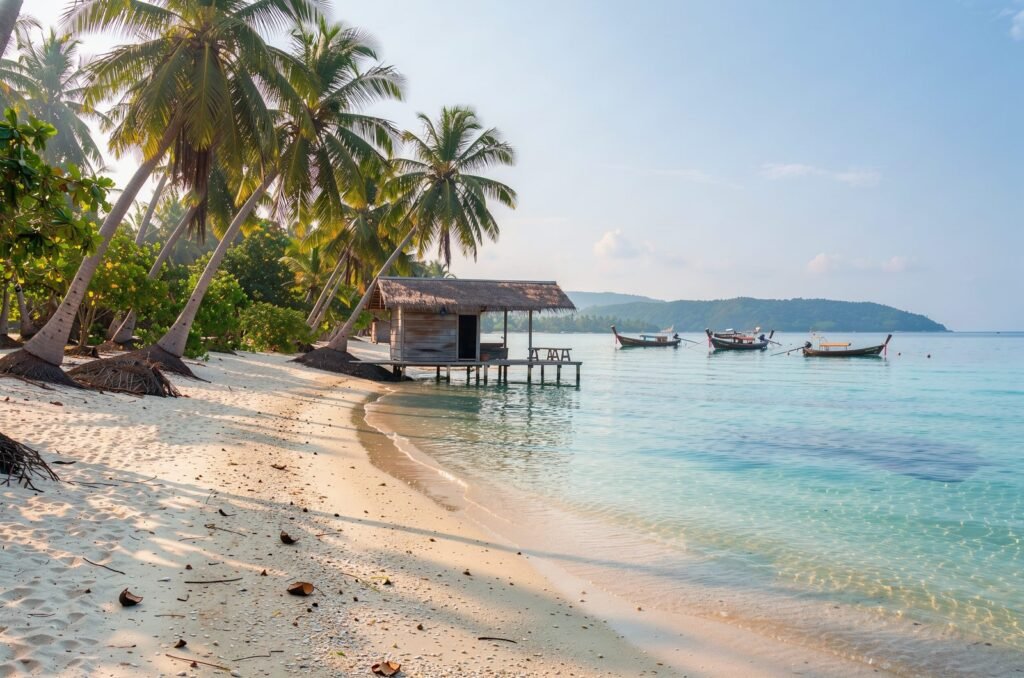
Koh Samui, Koh Phangan and Koh Tao
In the Gulf of Thailand, Koh Samui offers resorts, waterfalls and beaches such as Chaweng and Lamai. Koh Phangan is known for its Full Moon Party but also has quiet coves in the north, while small Koh Tao is one of the most popular places in the world to learn to dive.
Kanchanaburi
About two to three hours west of Bangkok, Kanchanaburi combines history and nature. Visit the Bridge over the River Kwai and the war cemeteries that recall the Death Railway built by prisoners of war in the Second World War, then swim in the turquoise pools of the seven-tiered Erawan Falls.

Khao Yai National Park
Khao Yai, part of the Dong Phayayen–Khao Yai Forest Complex UNESCO World Heritage Site, is Thailand’s oldest national park and lies about three hours north-east of Bangkok. Join a guided walk to spot gibbons, hornbills and, with luck, wild elephants, and visit the Haew Suwat waterfall.

Pattaya and Hua Hin
Pattaya, two hours from Bangkok, is known for nightlife but also has family attractions and the wooden Sanctuary of Truth. Hua Hin, a royal seaside town on the western side of the Gulf, is quieter and popular for long beach walks and golf.
Thai food
Thai cuisine balances sweet, sour, salty and spicy flavours, and some of the best food is found at street stalls and markets. Dishes to try:
- Pad Thai: stir-fried rice noodles with egg, tamarind, peanuts and shrimp or tofu.
- Tom yum goong: hot and sour soup with prawns, lemongrass and lime leaves.
- Green curry and massaman curry: rich coconut curries, the latter with Persian influences.
- Som tam: spicy green papaya salad from the north-east.
- Khao soi: curry noodle soup, the signature dish of Chiang Mai.
- Mango sticky rice: sweet coconut sticky rice with fresh mango, best in the mango season from March to May.
- Cha yen: sweet, bright orange Thai iced tea.


Restaurants worth booking
- Gaggan, Bangkok: Gaggan Anand’s playful, progressive Indian tasting menu, one of Asia’s best-known restaurants.
- Nahm, Bangkok: refined Thai cooking at the COMO Metropolitan hotel.
- Bo.lan, Bangkok: traditional Thai sharing menus with a focus on local, sustainable produce.
- Raan Jay Fai, Bangkok: the famous street-food stall known for its crab omelette and drunken noodles; expect a long queue.
- Baan Khanitha, Bangkok: classic Thai dishes in an elegant setting, a good choice for a first dinner in the city.
Where to stay in Thailand
- Mandarin Oriental, Bangkok: the legendary riverside hotel, open since 1876.
- Capella Bangkok: a calm luxury hotel on the Chao Phraya River where every room has a river view.
- Four Seasons Resort Chiang Mai: pavilions set among rice terraces in the Mae Rim valley.
- Four Seasons Tented Camp Golden Triangle: an all-inclusive luxury jungle camp where Thailand, Laos and Myanmar meet.
- Anantara Golden Triangle Elephant Camp & Resort: a resort in the far north with views over the Mekong and Ruak rivers.
- Banyan Tree Phuket: a pool villa resort in the Laguna area on Bang Tao Bay.
- Rayavadee, Krabi: pavilions in a tropical garden on the Phra Nang peninsula, between three beaches at Railay.
Compare prices: check current rates for hotels in Bangkok, hotels in Phuket and hotels in Chiang Mai on Booking.com.
Thailand itinerary ideas
- 10 days, first visit: 3 days in Bangkok (with a day trip to Ayutthaya), 3 days in Chiang Mai, then 4 days on the beach in Krabi or Phuket.
- 2 weeks, culture and islands: Bangkok, Ayutthaya, Sukhothai and Chiang Mai by train, then fly south for a week on Koh Lanta, Railay and Koh Phi Phi.
- Summer route (July to August): Bangkok, then the Gulf islands of Koh Samui, Koh Phangan and Koh Tao, which are drier than the Andaman coast at that time.
- Nature and history: Bangkok, Kanchanaburi and Erawan Falls, then Khao Yai National Park.
Practical tips for travelling in Thailand
- Fill in the TDAC within three days before you land and keep the QR code on your phone.
- Pack a light scarf or sarong so you can cover your shoulders when visiting temples.
- Download Grab or Bolt for fair taxi fares, and use the BTS and MRT to beat Bangkok’s traffic.
- ATMs charge foreign cards a fee of around 220 to 250 baht per withdrawal, so take out larger amounts at once.
- Plugs are mostly type A, B, C and O with 220 V; a universal adapter is useful.
- Tipping is not compulsory, but rounding up or leaving 20 to 50 baht for good service is appreciated.
Book your trip to Thailand
A few services we find useful when planning a trip to Thailand:
- Tickets and tours: tickets and tours in Bangkok on Tiqets
- Day trips and transfers: day trips, river cruises and airport transfers in Bangkok on Klook
- Mobile data: an eSIM for Thailand from Airalo, so you are online as soon as you land
Some links in this section are affiliate links. If you book through them, CountryDiscover may earn a small commission at no extra cost to you.
Conclusion
Thailand is easy to love: you can spend the morning in a centuries-old temple, the afternoon at a floating market or on a long-tail boat, and the evening eating some of the best food in the world for a few euros. Choose the right coast for the season, respect local customs and leave time to slow down on the islands or in the mountains of the north. For more inspiration, read our guides to Japan, the Maldives and Australia.