
South Korea
Explore South Korea: A Complete Travel Guide
South Korea combines ultra-modern cities with ancient palaces, Buddhist temples in the mountains, volcanic islands and one of the most exciting food scenes in Asia. Seoul is a 24-hour metropolis of neon-lit shopping streets, royal palaces and traditional hanok villages; Busan is a lively port city with beaches and seafood markets; and Jeju Island offers volcanic landscapes and coastal trails. Thanks to fast trains and excellent public transport, you can see a lot in a short time. This guide covers the best time to visit, entry rules, getting around, costs, culture, the top places to visit, food and where to stay.
South Korea travel guide: the essentials
- Capital: Seoul. Other major cities are Busan, Incheon, Daegu and Daejeon.
- Currency: South Korean won (KRW). Cards and contactless payments are accepted almost everywhere.
- Language: Korean, written in the Hangul alphabet. English signage is common in cities and on public transport.
- Entry: citizens of many countries can visit visa-free; some need a K-ETA or an e-Arrival card (see below).
- Electricity: 220 V with type C and F plugs, the same as most of Europe.
- Best for: city breaks, food, K-culture, history, temples, hiking and autumn colours.

Contents
- Best time to visit South Korea
- Visas, K-ETA and entry rules
- Getting around South Korea
- Travel costs in 2026
- Safety and practical matters
- Culture and etiquette
- Top places to visit
- Korean food and where to eat
- Where to stay
- Itinerary ideas
- Practical tips
Best time to visit South Korea
- Spring (April to May): cherry blossoms in early April and pleasant temperatures. One of the most popular times to visit.
- Summer (June to August): hot and humid, with the monsoon season (jangma) from late June to July. Good for beaches in Busan and Jeju.
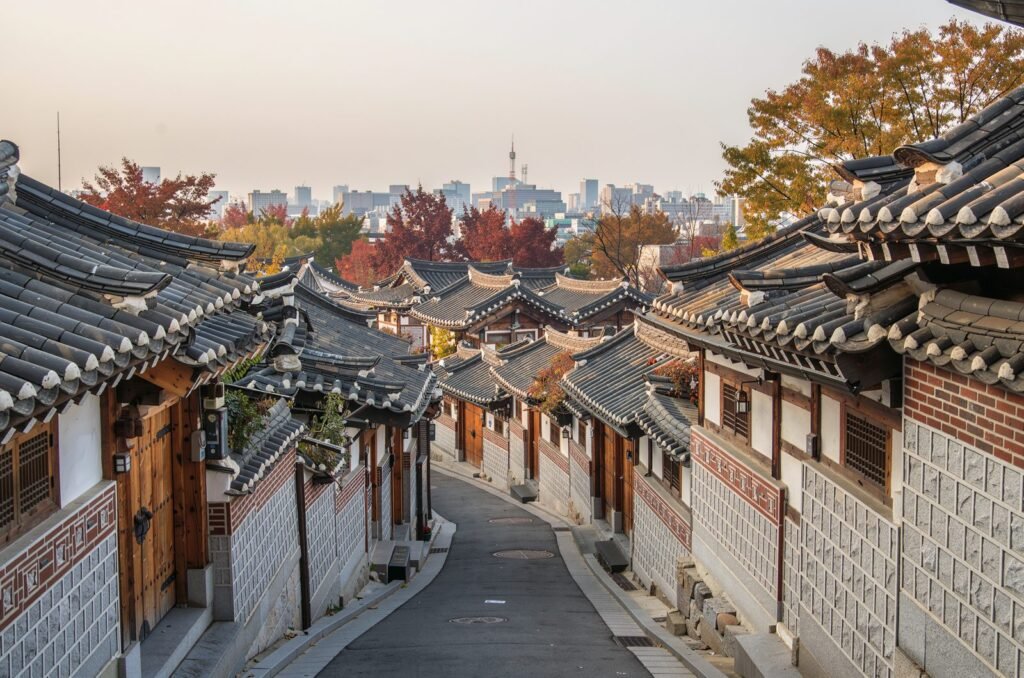
- Autumn (September to November): clear skies and spectacular autumn leaves, peaking in the mountains in October and in Seoul in late October and early November. Many consider this the best season.
- Winter (December to February): cold and dry, often below freezing in Seoul, with skiing in Gangwon province and winter festivals.
Avoid the Chuseok (autumn harvest) and Seollal (Lunar New Year) holidays if you can, as transport is busy and some shops and restaurants close.
Visas, K-ETA and entry rules
- Visa-free entry: citizens of more than 100 countries can visit South Korea without a visa for short stays, usually up to 90 days.
- K-ETA: most visa-free travellers normally need a Korea Electronic Travel Authorization before departure. However, citizens of 22 countries and regions, including the Netherlands, Belgium, Germany, France, the United Kingdom, the United States, Canada, Australia and Japan, are temporarily exempt until 31 December 2026. Check the official K-ETA website for the rules that apply on your travel date.
- e-Arrival card: travellers who are exempt from the K-ETA fill in an arrival card, which can be done online up to three days before arrival.
- Passport: your passport must be valid for the length of your stay; six months of validity is recommended.
Getting around South Korea
- By train: the high-speed KTX connects Seoul with Busan in about two and a half hours, and also serves Daejeon, Daegu, Gyeongju and Gangneung. The Korail Pass for foreigners offers unlimited train travel for a set number of days.
- In the cities: Seoul and Busan have excellent metro networks. A T-money card works on metros, buses and in taxis and convenience stores.
- By bus: express and intercity buses reach places without a train station and are cheap and comfortable.
- By plane: the short flight to Jeju is one of the busiest air routes in the world, with frequent departures from Seoul Gimpo and Busan.
- Navigation: Google Maps has limited functions in South Korea; download Naver Map or KakaoMap for directions and public transport.

Travel costs in 2026
- Accommodation: a guesthouse or hostel costs about ₩30,000 to ₩60,000 a night, a mid-range hotel ₩100,000 to ₩200,000, and a luxury hotel in Seoul more than ₩400,000.
- Food: a simple meal in a local restaurant costs about ₩9,000 to ₩15,000; Korean barbecue for two around ₩50,000 to ₩80,000.
- Transport: a metro ride in Seoul costs around ₩1,500; a KTX ticket from Seoul to Busan about ₩60,000.
- Tipping: not expected in Korea.
- Daily budget: plan on about €60 to €90 per person a day for budget travel and €120 to €200 for mid-range travel.
Safety and practical matters
South Korea is one of the safest countries in Asia, with very low crime rates, and the cities are safe to walk around at night. Tourism is booming: a record 18.94 million foreign visitors came in 2025, and that record was already broken in October 2026. Book popular hotels and attractions in Seoul ahead, especially in spring and autumn.
Tension with North Korea occasionally makes the news, but daily life is normally unaffected. Keep an eye on official travel advice and follow local instructions. Emergency numbers are 112 (police) and 119 (fire and ambulance); the 1330 Korea Travel Hotline helps visitors in English and other languages.
Culture and etiquette
Korean culture blends Confucian traditions with an energetic modern pop culture. K-pop, K-dramas and Korean cinema have made the country hugely popular, and many visitors come to see filming locations or try on a hanbok, the traditional dress, in Seoul’s palaces.
- Bow slightly when greeting people, and use both hands to give or receive things.
- Remove your shoes when entering homes, some restaurants and temples.
- Respect elders: they are served first and you wait for them to start eating.
- Do not stick chopsticks upright in your rice, and pour drinks for others rather than for yourself.
- Learn a few words of Korean, such as “annyeonghaseyo” (hello) and “gamsahamnida” (thank you). The Hangul alphabet is easy to learn in an afternoon.


Top places to visit in South Korea
Seoul
Visit the royal palaces of Gyeongbokgung and Changdeokgung, stroll through Bukchon Hanok Village, shop in Myeongdong and Hongdae, eat at Gwangjang Market and enjoy the view from N Seoul Tower or the Lotte World Tower.

Busan
South Korea’s second city has Haeundae and Gwangalli beaches, the colourful Gamcheon Culture Village, Jagalchi fish market and the seaside Haedong Yonggungsa temple.

Jeju Island
A volcanic island with the Seongsan Ilchulbong crater, Hallasan, the country’s highest mountain, lava tubes, waterfalls and the Jeju Olle coastal walking trails.

Gyeongju
The capital of the ancient Silla kingdom, often called a museum without walls, with royal tombs, Bulguksa Temple, Seokguram Grotto and the illuminated Donggung Palace and Wolji Pond.

Seoraksan National Park
Dramatic granite peaks and temples on the east coast, especially beautiful in October. Combine it with the beaches of Sokcho and Gangneung.

The DMZ
The demilitarised zone on the border with North Korea can be visited on organised tours from Seoul. The sites that can be visited change from time to time, so book with a licensed operator and bring your passport.

Other cities
Jeonju is famous for its hanok village and bibimbap, Andong for Hahoe Folk Village, and Daejeon and Incheon for modern architecture and science museums.

Korean food and where to eat
Korean food is bold, spicy and made for sharing. Every meal comes with banchan, small side dishes such as kimchi. Must-tries are Korean barbecue (samgyeopsal and bulgogi), bibimbap, kimchi jjigae stew, fried chicken with beer (chimaek), tteokbokki rice cakes and the street food at markets such as Gwangjang.


Recommended restaurants
- Mingles, Seoul: modern Korean cuisine and one of the most acclaimed restaurants in the country.
- Jungsik, Seoul: the pioneer of “new Korean” fine dining.
- Myeongdong Kyoja, Seoul: famous for its kalguksu noodle soup and dumplings since 1966.
- Gwangjang Market, Seoul: bindaetteok (mung bean pancakes), mayak gimbap and other street food.
- Jagalchi Market, Busan: choose your seafood downstairs and have it cooked upstairs.
Where to stay
In Seoul, stay near Myeongdong or Jongno for sightseeing, Hongdae for nightlife or Gangnam for business and shopping. A night in a traditional hanok guesthouse is a memorable experience.
- Four Seasons Hotel Seoul: luxury near Gyeongbokgung Palace.
- Signiel Seoul: on the top floors of the Lotte World Tower, one of the tallest buildings in the world.
- Lotte Hotel Seoul: a classic in Myeongdong.
- JW Marriott Hotel Seoul: in Gangnam, connected to a large shopping centre.
- Banyan Tree Club & Spa Seoul: a resort on the slopes of Namsan.
- Lotte Hotel Busan: a convenient base in central Busan.
Compare prices: check current rates for hotels in Seoul, hotels in Busan and hotels on Jeju Island on Booking.com.
Itinerary ideas
- Five days: Seoul (4 days) with a day trip to the DMZ or Suwon’s Hwaseong Fortress.
- One week: Seoul (4 days), then the KTX to Gyeongju (1 day) and Busan (2 days).
- Ten days: Seoul, Jeonju, Gyeongju, Busan and a flight to Jeju for three days.
- Autumn special: add Seoraksan and the east coast to any route in October.
Practical tips
- Check whether you need a K-ETA or an e-Arrival card before you fly.
- Download Naver Map or KakaoMap, plus Papago for translation.
- Buy a T-money card at the airport or any convenience store.
- Get an eSIM or rent a pocket Wi-Fi; Wi-Fi is fast and widely available.
- Book KTX tickets in advance at weekends and during holidays.
- Book palaces and other sites in advance during cherry blossom and autumn leaf season.
Book your trip to South Korea
A few services we find useful when planning a trip to South Korea:
- Hotels: compare hotels in Seoul on Booking.com
- Mobile data: an eSIM for South Korea from Airalo, so you are online as soon as you land
Some links in this section are affiliate links. If you book through them, CountryDiscover may earn a small commission at no extra cost to you.
Conclusion
South Korea is safe, efficient and full of surprises, from the palaces and street food of Seoul to the beaches of Busan and the volcanic landscapes of Jeju. Visit in spring or autumn, check the K-ETA rules before you go and leave room in your schedule for the food. For more inspiration, read our guides to Japan, Thailand and India.