
Turkey
Explore Turkey: A Complete Travel Guide
Turkey (officially Türkiye) sits where Europe meets Asia, and few countries offer so much variety in one trip: the mosques and bazaars of Istanbul, the fairy chimneys and hot air balloons of Cappadocia, the white terraces of Pamukkale, Greek and Roman cities such as Ephesus, and hundreds of kilometres of turquoise coast. It is one of the most visited countries in the world: in 2025 it welcomed a record 63.9 million visitors, including 52.8 million foreign tourists.
This Turkey travel guide covers what you need to plan your trip: the best time to visit, how to get around by plane, high-speed train and bus, what things cost in 2026 including museum tickets, what to eat, and the cities and regions that deserve a place on your itinerary.
Turkey travel guide: the essentials
- Capital: Ankara. The largest city is Istanbul.
- Population: about 86 million
- Language: Turkish. English is common in hotels and tourist areas, much less in the interior; German and Russian are often spoken on the coast.
- Currency: Turkish lira (TRY, ₺). In November 2026 one euro buys roughly 56 lira. Because of high inflation, prices in lira change quickly, and museum tickets for foreigners are set in euros.
- Entry: citizens of most EU countries, the UK, the US and Canada can visit visa-free for up to 90 days within 180 days. Check your own nationality on the official e-Visa site.
- Time zone: UTC+3 all year (no daylight saving time).
- Best time to visit: April to June and September to October.
- Plugs: type C and F, 230 V, the same as in most of Europe.
Contents
- Best time to visit Turkey
- Getting around: flights, trains and buses
- Costs and tickets in 2026
- History, flag and culture
- Turkish food and the best restaurants
- Famous Turks
- Istanbul
- Cappadocia
- Pamukkale, Ephesus and the Aegean coast
- The Turquoise Coast and Antalya
- Ankara, Konya, Bursa and the southeast
- The best beaches in Turkey
- Where to stay in Turkey
- Turkey itinerary ideas
- Practical Turkey travel tips
Best time to visit Turkey
The best months for most trips are April to June and September to October: warm and sunny, but without the extreme heat and crowds of high summer. The sea on the Mediterranean coast is warm enough to swim from late May to early November.
- July and August: peak beach season. Temperatures on the coast and in Pamukkale often pass 35°C, and Istanbul is hot and busy.
- Spring: wildflowers, tulips in Istanbul’s parks in April, and ideal weather for Ephesus, Pamukkale and hiking the Lycian Way.
- Autumn: warm sea, grape harvest in Cappadocia and the Aegean, and fewer tourists.
- Winter: cold and often snowy in the interior. Cappadocia under snow is beautiful, and there is good skiing at Erciyes near Kayseri and Uludağ near Bursa. Istanbul is mild and grey, the coast quiet.
- Ramadan: during the fasting month restaurants in tourist areas stay open, but some local eateries close during the day. The feasts that follow (Ramazan Bayramı and Kurban Bayramı) are busy travel periods for Turks themselves.
Getting around: flights, trains and buses
Turkey is large, so domestic flights are the fastest way to cover long distances. Turkish Airlines, AJet, Pegasus and SunExpress connect Istanbul with almost every city, often for little money. Istanbul has two main airports: Istanbul Airport (IST) on the European side and Sabiha Gökçen (SAW) on the Asian side. For Cappadocia, fly to Kayseri (ASR) or Nevşehir Kapadokya (NAV).
The high-speed train (YHT) is comfortable and cheap. The main lines run from Istanbul to Ankara in about four and a half hours, from Istanbul to Konya, from Ankara to Konya in less than two hours, and from Ankara to Sivas. Trains sell out, especially on Fridays and Sundays, so book early on the official TCDD ticket site. There is no train to Antalya, Bodrum, Fethiye or Cappadocia.
For everything else there are the long-distance buses, which are modern and frequent, with companies such as Metro, Kamil Koç and Pamukkale Turizm. In towns and on the coast, shared minibuses called dolmuş are the cheapest way to get around. Renting a car is a good option on the Aegean and Mediterranean coasts and in Cappadocia.
In Istanbul, buy an Istanbulkart for the metro, trams, buses and the ferries across the Bosphorus; a ferry ride between Europe and Asia is one of the best and cheapest experiences in the city.
Costs and tickets in 2026
Turkey is no longer the bargain it once was: inflation has pushed up prices, and Istanbul and resorts such as Bodrum can be as expensive as Western Europe. Outside the hotspots it is still good value, with a filling meal in a lokanta (a simple restaurant) for a few hundred lira. Some useful prices for foreign visitors in 2026:
- Hagia Sophia: €25 for the upper gallery with the Byzantine mosaics. The ground floor is a mosque, reserved for worshippers.
- Topkapı Palace: around €55; the Harem costs extra.
- Ephesus: €40, plus €15 for the Terrace Houses.
- Museum Pass Istanbul: €105 for five days, including Topkapı Palace with the Harem and Hagia Irene, the Archaeological Museums and Galata Tower (not Hagia Sophia). The price rises to €120 from 1 April 2027.
- Hot air balloon in Cappadocia: from about €80 in low season to €300 or more in peak months for a shared basket.
- Tipping: 5 to 10% in restaurants is appreciated.
Museum prices are charged in lira at the daily exchange rate, and cards are accepted at almost every ticket office. Buy tickets for state museums only at the gate or on the official muze.gov.tr site. Always pay in lira when a card machine asks you to choose the currency.
History, flag and culture
Anatolia has been home to some of the oldest civilisations in the world. Göbeklitepe, near Şanlıurfa, is more than 11,000 years old, older than Stonehenge and the pyramids. Later came the Hittites, the Greek cities of the Aegean coast, the Romans, the Byzantine Empire with its capital Constantinople, and from 1453 the Ottoman Empire, which ruled large parts of Europe, the Middle East and North Africa for centuries.
Mustafa Kemal Atatürk

After the First World War and the War of Independence, Mustafa Kemal Atatürk founded the Republic of Turkey on 29 October 1923 and became its first president. He moved the capital to Ankara and introduced far-reaching reforms, including the Latin alphabet, a secular state and women’s suffrage. He died in 1938; his mausoleum, Anıtkabir in Ankara, is one of the most visited places in the country, and his portrait is on every banknote.
The Turkish flag

The flag is red with a white crescent and a five-pointed star. It is based on the Ottoman flag and was officially standardised in 1936. Turks call it Ay Yıldız, “moon star”, and you will see it everywhere, from government buildings to balconies.
Map and geography

Turkey has 81 provinces. A small part, Eastern Thrace with half of Istanbul, lies in Europe; the rest is Anatolia in Asia, separated by the Bosphorus, the Sea of Marmara and the Dardanelles. The country borders eight countries and four seas: the Black Sea in the north, the Aegean in the west, the Mediterranean in the south and the inland Sea of Marmara. Its highest mountain is Mount Ararat (5,137 m) in the far east.
Currency and economy

The Turkish lira is divided into 100 kuruş, and every banknote carries Atatürk’s portrait. Turkey is a member of the G20, with a strong industrial base (cars, textiles, steel, household appliances), a large agricultural sector and a tourism industry that earned a record $65.2 billion in 2025. In recent years the economy has suffered from high inflation and a falling lira.
Traditions, music and dance

Hospitality is central to Turkish culture: you will be offered tea in shops, homes and even at the barber. Every region has its own folk dances, such as the energetic horon of the Black Sea coast and the halay danced in a line at weddings in the east. In Konya you can see the whirling dervishes of the Mevlevi order, whose sema ceremony is on UNESCO’s list of intangible heritage.

The bağlama or saz, a long-necked lute, is the heart of Turkish folk music. Ottoman classical music, Sufi music with the ney flute, arabesk and modern Turkish pop are all part of the soundtrack of the country; stars such as Tarkan and Sezen Aksu are known far beyond Turkey.
Architecture

Turkey’s architecture spans thousands of years, from Greek and Roman temples to Byzantine churches and the great Ottoman mosques of the architect Mimar Sinan, such as the Süleymaniye in Istanbul and the Selimiye in Edirne. Hagia Sophia, completed in 537, was the largest church in the world for nearly a thousand years and became a mosque in 1453, a museum in 1934 and a mosque again in 2020.
Festivals

The Istanbul Music Festival in June brings classical concerts to historic venues across the city. In late summer the İzmir International Fair, one of the oldest fairs in Turkey, fills the Kültürpark with concerts and exhibitions.

In the autumn the Antalya Golden Orange Film Festival, the oldest film festival in Turkey, rolls out the red carpet for Turkish cinema.

Turkish food and the best restaurants
Turkish cuisine is one of the great cuisines of the world, shaped by the Ottoman palace kitchens and by the produce of every region: olive oil dishes on the Aegean, fish on the Black Sea, spicy kebabs in the southeast and hearty dishes in central Anatolia.
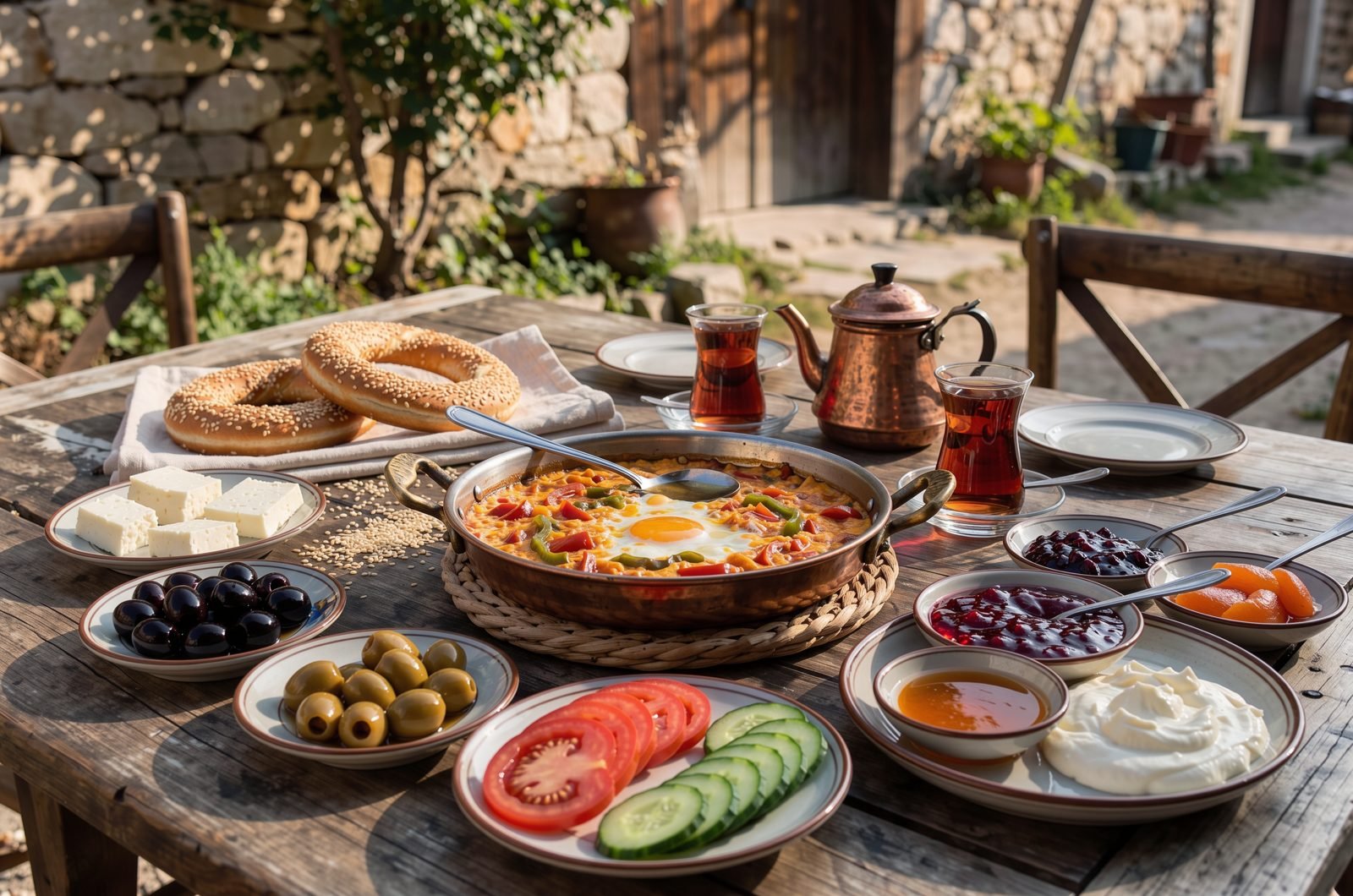
Start the day with a Turkish breakfast (kahvaltı): white cheese, olives, tomatoes and cucumbers, honey with kaymak cream, jams, simit and endless glasses of tea. On weekends Turks spend hours over a serpme kahvaltı, with dozens of small plates.
Menemen

Eggs scrambled with tomatoes, green peppers and spices, served in the pan with fresh bread. Whether it should contain onions is a national debate.
Kebab

There are dozens of kinds: the spicy Adana kebab, döner from the vertical spit, İskender kebab from Bursa with tomato sauce, butter and yoghurt, and the pistachio kebabs of Gaziantep.
Lahmacun and pide

Lahmacun is a thin, crispy flatbread with spiced minced meat, rolled up with parsley, onion and lemon. Pide is its boat-shaped cousin, filled with cheese, egg, meat or sucuk.
Dolma and sarma

Vine leaves, peppers or courgettes stuffed with rice, herbs and sometimes meat. The olive oil versions are served cold as meze.
Börek

Layers of thin yufka pastry filled with white cheese, spinach or minced meat, a favourite for breakfast and snacks.
Turkish desserts

Baklava, thin layers of pastry with nuts and syrup, is at its best in Gaziantep, the pistachio capital of Turkey.

Künefe from Hatay is a warm dessert of shredded pastry with melted cheese, soaked in syrup and topped with pistachios.

Lokum, Turkish delight, has been made in Istanbul since the 18th century, in flavours such as rose, pistachio and pomegranate.
Turkish coffee and tea

Turkish coffee is brewed in a small pot called a cezve and served unfiltered, with a glass of water and often a piece of lokum. Its culture and tradition are on UNESCO’s list of intangible heritage.

Tea (çay) is drunk even more: strong black tea from the Black Sea region, served in tulip-shaped glasses all day long. Turkey is one of the largest tea consumers in the world per person.
Best restaurants in Turkey
- TURK Fatih Tutak, Istanbul: one of only two restaurants in Turkey with two Michelin stars, with a creative tasting menu rooted in Turkish cuisine.
- Mikla, Istanbul: Mehmet Gürs’s Michelin-starred rooftop restaurant in Beyoğlu, with views over the Golden Horn.
- Neolokal, Istanbul: Maksut Aşkar’s modern Anatolian cooking in the SALT Galata building in Karaköy, with a Michelin star and Green Star.
- Nicole, Istanbul: a Michelin-starred tasting menu in a former monastery near Galata.
- Çiya Sofrası, Istanbul: Musa Dağdeviren’s restaurant in Kadıköy, famous for forgotten regional dishes from all over Anatolia.
- Hamdi, Istanbul: a classic for kebabs from the southeast, with a terrace overlooking the Golden Horn near the Spice Bazaar.
- Karaköy Lokantası, Istanbul: home-style Turkish dishes at lunch and meze with rakı in the evening.
- Vino Locale, Urla (İzmir): the first restaurant in İzmir with two Michelin stars, in the heart of Aegean wine country.
- OD Urla and Teruar Urla, Urla (İzmir): two Michelin-starred restaurants built around local Aegean produce.
- Maçakızı, Bodrum: a Michelin-starred restaurant at the legendary hotel of the same name in Türkbükü.
- Revithia, Ürgüp (Cappadocia): Cappadocia’s first Michelin-starred restaurant, with Anatolian recipes in a stone house.
- İmam Çağdaş, Gaziantep: a historic address for baklava and kebab near the old bazaar.
- 7 Mehmet, Antalya: a long-standing restaurant with Turkish and Mediterranean dishes and views over the bay.
The best food is often the simplest: eat fish sandwiches by the Galata Bridge, simit from a street cart, and the dish of the day in a busy lokanta where locals have lunch.
Famous Turks
Turkish TV series (dizi) are watched all over the world, from the Middle East and the Balkans to Latin America, and their stars are among the best known Turks today.
Kıvanç Tatlıtuğ

Born in Adana in 1983, Kıvanç Tatlıtuğ was a basketball player and model before he became one of Turkey’s most popular actors with series such as Gümüş, Aşk-ı Memnu and Kuzey Güney.
Burak Özçivit

Born in Istanbul in 1984, he is known for Muhteşem Yüzyıl, Kara Sevda (which won an International Emmy in 2017) and the historical series Kuruluş: Osman.
Hande Erçel

Born in Bandırma in 1993, Hande Erçel became famous with Aşk Laftan Anlamaz and the international hit Sen Çal Kapımı, and is one of the most followed Turkish actresses on social media.
Fahriye Evcen

Born in Solingen, Germany, in 1986, she starred in Yaprak Dökümü and Çalıkuşu. She is married to Burak Özçivit.
Can Yaman

Born in Istanbul in 1989, the former law graduate became a star with Erkenci Kuş and is especially popular in Italy, where he played the title role in the series Sandokan.
Aslı Enver

Born in London in 1984, Aslı Enver is known for Suskunlar and for her role as Süreyya in İstanbullu Gelin, which won her a Golden Butterfly award.
Istanbul

Istanbul, the former Byzantium and Constantinople, is the only major city in the world on two continents and the most visited city in Turkey, with almost 19 million foreign tourists in 2025. Plan at least four days. Most sights are in the old town of Sultanahmet; across the Golden Horn lie Galata and Beyoğlu, and on the Asian side the relaxed neighbourhoods of Kadıköy and Moda. Take a Bosphorus ferry, visit the Basilica Cistern, the Süleymaniye Mosque and the Spice Bazaar, and watch the sunset from Galata Tower.
Hagia Sophia

The masterpiece of Byzantine architecture is now a mosque again. Foreign visitors enter through a separate entrance on the east side and visit the upper gallery with the mosaics (€25). Dress modestly; women must cover their hair.
Blue Mosque

Opposite Hagia Sophia stands the Sultan Ahmed Mosque, named the Blue Mosque after the more than 20,000 blue İznik tiles inside. It is free to visit outside prayer times.
Topkapı Palace

For almost four centuries the Ottoman sultans lived here, on the point where the Bosphorus meets the Golden Horn. See the Harem, the treasury with the Spoonmaker’s Diamond, the sacred relics and the views from the terraces. Go early, as queues build fast.
Grand Bazaar

One of the oldest and largest covered markets in the world, with around 4,000 shops selling carpets, lamps, jewellery, leather and ceramics. Bargaining is expected. The bazaar is closed on Sundays.
Taksim and İstiklal Avenue

Taksim Square is the heart of modern Istanbul. From here the pedestrian İstiklal Avenue, with its nostalgic red tram, leads to Galata through a mix of shops, churches, cafés and side streets full of bars and meyhanes.
Cappadocia

Cappadocia, in central Anatolia, is a fairytale landscape of volcanic rock, eroded into fairy chimneys, canyons and cliffs full of cave houses and Byzantine churches. Take a sunrise balloon flight, visit the frescoed churches of the Göreme Open Air Museum, explore the underground cities of Derinkuyu and Kaymaklı, and hike through the Rose, Red and Love valleys. Göreme, Uçhisar and Ürgüp are the best bases, with many cave hotels. Balloons only fly in good weather, so plan at least two mornings.
Pamukkale, Ephesus and the Aegean coast
Pamukkale

Pamukkale, the “cotton castle”, is a hillside of white travertine terraces formed by warm mineral springs. You walk barefoot on the terraces up to the ruins of the Roman spa town of Hierapolis, where you can swim among ancient columns in the Antique Pool. Come early or late in the day to avoid the heat and the crowds.
Ephesus

Ephesus near Selçuk is one of the best preserved ancient cities in the Mediterranean. Walk the marble streets past the Library of Celsus, the Great Theatre, which seated around 25,000 people, and the Terrace Houses with their mosaics and frescoes. Nearby are the House of the Virgin Mary and the Basilica of St. John. Kuşadası and Şirince are good places to stay.
İzmir

Turkey’s third city is relaxed, liberal and right on the sea. Stroll along the Kordon promenade, visit the Kemeraltı bazaar and the clock tower on Konak Square, and take day trips to the beaches of Çeşme and Alaçatı and the wine and food town of Urla.
Bodrum

The most glamorous resort on the Aegean, with whitewashed houses, the Castle of St. Peter with its Museum of Underwater Archaeology, a lively marina and many coves around the peninsula, from Gümüşlük to Türkbükü and Yalıkavak.
The Turquoise Coast and Antalya
Between Fethiye and Antalya the Taurus Mountains plunge into a sea of every shade of blue. This is the Turquoise Coast, ideal for a road trip or a multi-day boat trip on a traditional wooden gulet. Highlights are the Blue Lagoon at Ölüdeniz with paragliding from Babadağ, the sunken city of Kekova, the small harbour towns of Kaş and Kalkan, and the 540 km Lycian Way hiking trail.
Antalya

Antalya is the gateway to the Turkish Riviera and, after Istanbul, the most visited place in Turkey. Stay in the old town of Kaleiçi with its Ottoman houses and Roman harbour, swim at Konyaaltı or Lara beach, and visit the Düden waterfalls, the Roman theatre of Aspendos and the ancient cities of Perge and Side.
Alanya

Alanya is known for its octagonal Red Tower (Kızıl Kule), the castle on the rock high above the town and Cleopatra Beach. It is a popular, good-value resort for families.
Ankara, Konya, Bursa and the southeast
Ankara

The capital is a modern, government city, but well worth a day: visit Anıtkabir, Atatürk’s mausoleum, the excellent Museum of Anatolian Civilizations with finds from the Hittites and earlier, and the old citadel.
Bursa

The first capital of the Ottoman Empire lies at the foot of Mount Uludağ. See the Grand Mosque (Ulu Cami), the Green Mosque and Green Tomb, the silk market in the Koza Han and the village of Cumalıkızık. Bursa is the birthplace of İskender kebab.
Konya

Konya is the spiritual heart of Turkey and the city of the 13th-century poet and mystic Rumi (Mevlana). His mausoleum with the turquoise dome is now the Mevlana Museum. Every December the city hosts a festival with performances by the whirling dervishes. Konya is reached by high-speed train from Istanbul and Ankara.
Adana and Mersin

In the south, Adana is the home of the spicy Adana kebab and the huge Sabancı Central Mosque on the Seyhan River. Nearby Mersin is known for tantuni, a wrap of finely chopped meat, and for the ancient sites along the coast. Further east, Gaziantep is famous for baklava, Şanlıurfa for Göbeklitepe, and Hatay for its food, though Antakya is still rebuilding after the earthquakes of February 2023.
Diyarbakır

Diyarbakır on the Tigris is one of the oldest cities in the region, surrounded by kilometres of black basalt walls that are a UNESCO World Heritage site together with the Hevsel Gardens. Check your government’s travel advice before visiting the southeast, particularly the areas near the Syrian border.
The best beaches in Turkey
- Ölüdeniz, Fethiye: the famous Blue Lagoon, with calm, crystal clear water and paragliders landing on the beach.
- Patara: an 18 km sandy beach next to the ruins of an ancient Lycian city, and a nesting site for loggerhead turtles.
- Kaputaş, near Kaş: a small cove at the bottom of a gorge, with water in impossible shades of blue.
- İztuzu, Dalyan: a long sandbar between the sea and the river, also protected for sea turtles.
- Konyaaltı, Antalya: a long city beach with the Taurus Mountains as a backdrop.
- Cleopatra Beach, Alanya: fine sand right below the castle.
- Altınkum and Ilıca, Çeşme: shallow, clear water on the Aegean, ideal for families.


Where to stay in Turkey
- Pera Palace Hotel, Istanbul: a historic hotel from 1892, built for passengers of the Orient Express; Agatha Christie and Atatürk stayed here.
- Four Seasons Hotel Istanbul at Sultanahmet: a luxury hotel in a former prison, a few minutes’ walk from Hagia Sophia and the Blue Mosque.
- Çırağan Palace Kempinski, Istanbul: a former Ottoman palace on the Bosphorus with one of the most beautiful pools in the city.
- The Peninsula Istanbul: a modern luxury hotel on the waterfront in Karaköy.
- Museum Hotel, Uçhisar (Cappadocia): cave suites with antiques and a pool with views of the balloons.
- Argos in Cappadocia, Uçhisar: rooms in restored cave houses and an old monastery, with its own wine cellars.
- Tuvana Hotel, Antalya: a boutique hotel in restored Ottoman houses in the old town of Kaleiçi.
- Concorde De Luxe Resort, Antalya: a large all-inclusive resort on Lara Beach.
- Hillside Beach Club, Fethiye: a family resort in its own pine-fringed bay.
- Maçakızı, Bodrum: a legendary boutique hotel in Türkbükü with wooden sun decks over the sea.
- Mandarin Oriental Bodrum: luxury on a hillside above Paradise Bay.
Compare prices: check current rates for hotels in Istanbul, cave hotels in Göreme and beach hotels in Antalya on Booking.com.
Turkey itinerary ideas
- 10 days, the classics: 4 days Istanbul, fly to Cappadocia for 3 days, then fly to İzmir or Denizli for Ephesus and Pamukkale (3 days).
- 2 weeks, culture and coast: 4 days Istanbul, 3 days Cappadocia, 2 days Pamukkale and Ephesus, then 5 days on the Turquoise Coast between Fethiye and Kaş.
- 1 week, by train: 3 days Istanbul, high-speed train to Konya (2 days) and on to Ankara (1 day), then fly or take the bus to Cappadocia.
Practical Turkey travel tips
- Dress modestly when visiting mosques: shoulders and knees covered, and a headscarf for women. Avoid visits during Friday noon prayers.
- Drink bottled water rather than tap water.
- Learn a few words of Turkish: merhaba (hello), teşekkür ederim (thank you) and lütfen (please) make a big difference.
- Agree on the price before taking a taxi without a meter, or use BiTaksi or Uber in Istanbul.
- Bargaining is normal in bazaars, but not in shops with fixed prices or restaurants.
- Get a local SIM or eSIM on arrival; a foreign phone works with a Turkish SIM for up to 120 days without registration.
- Travel insurance with medical cover is recommended; private hospitals are good but expensive for foreigners.
Book your trip to Turkey
A few services we find useful when planning a trip to Turkey:
- Tickets and tours: skip-the-line tickets and tours in Istanbul on Tiqets
- Car rental: compare rental cars on Economybookings.com
- Mobile data: an eSIM for Turkey from Airalo, so you are online as soon as you land
Some links in this section are affiliate links. If you book through them, CountryDiscover may earn a small commission at no extra cost to you.
Conclusion
Turkey rewards every kind of traveller: history lovers in Istanbul and Ephesus, adventurers in Cappadocia and on the Lycian Way, food lovers everywhere, and beach lovers on the Aegean and the Turquoise Coast. Go in spring or autumn, combine a city with the coast, and take time to drink tea with the locals.

Planning a longer trip? Read our guides to Greece, Italy and Spain, or explore every country on our interactive world map.