
Mexico
Explore Mexico: A Complete Travel Guide
Mexico is one of the most rewarding countries in the world to travel: Maya pyramids rising out of the jungle, turquoise Caribbean beaches, colonial towns painted in every colour, a capital that ranks among the great food cities on earth, and traditions such as Day of the Dead that you will not find anywhere else. In 2025 the country welcomed a record 47.8 million international overnight tourists, and it is easy to see why.
This Mexico travel guide covers what you need to plan your trip: the best time to visit, how to get around by plane, bus and the new Tren Maya, what things cost in 2026 including the tourist fees, what to eat, how to stay safe, and the regions and cities that deserve a place on your itinerary.

Mexico travel guide: the essentials
- Capital: Mexico City (CDMX)
- Population: about 130 million
- Language: Spanish. Mexico also recognises 68 indigenous languages, including Nahuatl and Yucatec Maya. English is widely spoken in Cancún, Tulum, Los Cabos and Puerto Vallarta, much less in the countryside.
- Currency: Mexican peso (MXN). In November 2026 one US dollar buys roughly 18.5 pesos.
- Entry: travellers from the EU, the UK, the US and Canada do not need a visa for a tourist stay; the immigration officer decides how many days you get, up to 180.
- Time zones: four, from Quintana Roo (Cancún) in the east to Baja California in the west.
- Best time to visit: November to April for dry, sunny weather in most of the country.
- Plugs: type A and B, 127 V, the same as in the United States.
Contents
- Best time to visit Mexico
- Getting around: flights, buses and the Tren Maya
- Costs, tourist fees and tickets in 2026
- Is Mexico safe?
- Culture, flag and traditions
- Mexican food and the best restaurants
- Famous Mexicans
- Mexico City and Teotihuacán
- Cancún, the Riviera Maya and the Yucatán
- Oaxaca and Palenque
- Guadalajara, San Miguel de Allende and Monterrey
- Puerto Vallarta and the Pacific coast
- Where to stay in Mexico
- Mexico itinerary ideas
- Practical Mexico travel tips
Best time to visit Mexico
For most of the country the best time to visit is November to April, the dry season. Days are sunny, humidity is lower and the Caribbean is at its clearest. Christmas, New Year and Easter (Semana Santa) are the busiest and most expensive weeks, so book early if you travel then.
- November to April: high season on the beaches; pleasant and dry in Mexico City, Oaxaca and the colonial highlands, with cool nights at altitude.
- May: the hottest month in the Yucatán and the interior, often above 35°C, but quieter and cheaper.
- June to October: rainy season. In the highlands it usually means a short, heavy shower in the afternoon. The Atlantic and Pacific hurricane seasons run from June to November, with the highest risk in September and October.
- Sargassum seaweed: on the Caribbean coast (Cancún, Playa del Carmen, Tulum) seaweed can wash ashore from roughly April to October, with the peak in June, July and August. 2026 was the heaviest season ever recorded. From November to March the beaches are usually clean, and Isla Mujeres and the northern Cancún Hotel Zone tend to be least affected.
- Festivals worth planning around: Day of the Dead (1 and 2 November), Independence Day (the night of 15 September and 16 September) and the Guelaguetza in Oaxaca (the last two Mondays of July).
Getting around: flights, buses and the Tren Maya
Mexico is big: it is almost 3,000 km from Tijuana to Cancún. For long distances, domestic flights with Aeroméxico, Volaris and Viva are fast and often cheap. Mexico City has two main airports, Benito Juárez (MEX) and the newer Felipe Ángeles (NLU) north of the city, so check which one your ticket uses.
For shorter trips the first-class buses are excellent: comfortable, air-conditioned and punctual. ADO covers the south and the Yucatán, and ETN and Primera Plus serve the centre and west. Book online or at the terminal.
The Tren Maya is the big novelty. The 1,554 km line has 34 stations across five states and connects Cancún Airport, Puerto Morelos, Playa del Carmen, Tulum, Tulum Airport, Bacalar, Chetumal, Valladolid, Chichén Itzá, Mérida, Campeche and Palenque. It is comfortable and avoids the busy highway, but trains run less often than buses, so check the timetable on the official Tren Maya website before you plan around it.
Renting a car works well in the Yucatán Peninsula, where roads are good and quiet. Elsewhere, avoid driving at night, use toll roads (cuotas) where possible, and use Uber, DiDi or authorised taxis (sitio) in the cities rather than hailing a cab on the street.
Costs, tourist fees and tickets in 2026
Mexico can be done on a backpacker budget or in great luxury. In Oaxaca or Mérida a street taco costs from 20 pesos and a good mid-range hotel around 1,200 to 2,000 pesos a night. Cancún, Tulum and Los Cabos are much more expensive, with prices close to those in the United States. A few fees are worth knowing about:
- Non-resident fee (DNR): 983 pesos per person for tourists in 2026. If you fly in, it is usually already included in your ticket.
- Visitax (Quintana Roo): every foreign visitor to Cancún, Playa del Carmen, Tulum, Cozumel or Isla Mujeres must pay this state tax, about 285 pesos (roughly US$15) per person per stay. Pay only on the official visitax.gob.mx site; copycat sites charge double. Cancún Airport checks the QR code before departure.
- Chichén Itzá: 697 pesos for foreign adults in 2026 (a federal INAH ticket plus a Yucatán state fee).
- Teotihuacán: 210 pesos for foreign adults.
- Tulum ruins: since July 2026 foreigners pay 100 pesos for Parque del Jaguar plus a combined 165-peso ticket for the national park and the archaeological zone.
- Tipping: 10 to 15% in restaurants is normal; check whether service (propina) is already on the bill.
Credit cards are accepted in hotels and most restaurants, but carry cash for markets, small eateries, buses and ticket offices at archaeological sites. Use ATMs inside banks or shopping centres and always choose to be charged in pesos.
Is Mexico safe?
Millions of tourists visit Mexico every year without problems, but safety varies greatly by region. Governments rate each state separately: the Yucatán and Campeche are among the calmest, the main tourist areas such as Mexico City, Oaxaca and Quintana Roo come with a warning to take extra care, and states such as Guerrero, Michoacán, Sinaloa and Tamaulipas are best avoided. Always check your own government’s travel advice before you go.
The usual precautions go a long way: use authorised taxis or ride-hailing apps, do not travel by road at night, keep valuables out of sight, use ATMs inside banks, and be careful with drinks in nightlife areas.
Culture, flag and traditions
Modern Mexico grew out of great pre-Hispanic civilisations, among them the Olmecs, the Maya, Teotihuacán, the Zapotecs and the Aztecs, followed by three centuries of Spanish rule that ended with independence in 1821. That double heritage is visible everywhere: in the food, the language, the churches built on top of temples and the festivals that mix Catholic and indigenous beliefs.
The Mexican flag

The flag has three vertical stripes in green, white and red. In the centre is the coat of arms: an eagle on a prickly pear cactus devouring a snake. It recalls the Aztec legend in which the god Huitzilopochtli told his people to build their city where they saw this sign; that place became Tenochtitlan, today Mexico City.
Map and geography

Mexico has 32 federal entities: 31 states plus Mexico City, which became a federal entity in its own right in 2016. The country stretches from the deserts of the north via the volcanic highlands of the centre to the tropical jungle of Chiapas and the flat limestone Yucatán Peninsula, with a long Pacific coast in the west and the Gulf of Mexico and the Caribbean in the east.
Currency and economy

The Mexican peso is divided into 100 centavos. Coins come in 50 centavos and 1, 2, 5, 10 and 20 pesos, and notes in 20, 50, 100, 200, 500 and 1,000 pesos. According to the 2025 survey of the Bank for International Settlements, the peso is the most traded currency in Latin America and the 14th most traded in the world.
Mexico is the second largest economy in Latin America after Brazil and ranks around 13th in the world. Car manufacturing, electronics, oil, silver mining (Mexico is the world’s largest silver producer), agriculture and tourism are the main pillars, and most exports go to the United States.
Art, festivals and traditions
Mexico gave the world the murals of Diego Rivera, José Clemente Orozco and David Alfaro Siqueiros and the self-portraits of Frida Kahlo, whose Casa Azul in Coyoacán is one of the most visited museums in the capital. Traditional Mexican cuisine and mariachi music are both on UNESCO’s list of intangible cultural heritage.
The most important festival for travellers is Día de Muertos, the Day of the Dead, on 1 and 2 November. Families build altars (ofrendas) with marigolds, candles, sugar skulls and the favourite food of their loved ones, and spend the night in decorated cemeteries. Oaxaca, Pátzcuaro and Mexico City are the best places to experience it, always with respect for the families.

A common misunderstanding: Cinco de Mayo is not Mexico’s Independence Day. It commemorates the victory over the French army at the Battle of Puebla in 1862 and is celebrated mainly in Puebla and in the United States. The real national holiday is 16 September, starting the night before with the “Grito de Dolores” in every town square.
Traditional dances

Every region has its own dances. The best known is the jarabe tapatío from Jalisco, the “Mexican hat dance”, performed to mariachi music with the women in wide, colourful skirts. Other highlights are the danza de los Voladores from Veracruz, where performers spin down from a high pole, and the many dances of the Guelaguetza in Oaxaca. The Ballet Folklórico de México performs at the Palacio de Bellas Artes in Mexico City.
Mexican food and the best restaurants
Mexican food in Mexico is very different from Tex-Mex abroad: fresher, more regional and built on corn, beans, chillies, tomatoes and herbs. Every state has its own specialities, so eat locally wherever you go.
Tacos

Soft corn tortillas filled with almost anything. Try tacos al pastor (marinated pork from a vertical spit with pineapple) in Mexico City, cochinita pibil (slow-cooked pork with achiote) in the Yucatán and fish tacos on the Baja coast.
Mole

A complex sauce of dried chillies, spices, nuts, seeds and sometimes chocolate, often with more than twenty ingredients. Puebla is famous for mole poblano and Oaxaca is known as the land of seven moles, of which the dark mole negro is the classic.
Ceviche

Raw fish or shrimp “cooked” in lime juice with tomato, onion, chilli and coriander, served with tostadas. Along the coasts you will also find aguachile, shrimp in a spicy lime and chilli sauce.
Guacamole

Mashed avocado with lime, onion, coriander and chilli, traditionally made in a stone molcajete. Mexico is by far the world’s largest avocado producer.
Tequila and mezcal

Tequila is made from blue agave and may only come from Jalisco and a few surrounding areas. The town of Tequila, an hour from Guadalajara, and its agave fields are a UNESCO World Heritage site. Mezcal, mostly from Oaxaca, is made from many types of agave roasted in underground pits, which gives it its smoky taste. Sip both slowly rather than as shots.
Best restaurants in Mexico
- Pujol, Mexico City: Enrique Olvera’s restaurant in Polanco, known for its mole madre, and the place that put modern Mexican cooking on the world map. Book weeks ahead.
- Quintonil, Mexico City: Jorge Vallejo’s tasting menu built around Mexican herbs, vegetables and small producers.
- Máximo, Mexico City: Eduardo García’s Michelin-starred restaurant in Roma Norte, with seasonal ingredients from farms around the city.
- Rosetta, Mexico City: Elena Reygadas cooks in a beautiful mansion in Roma; her bakery next door is famous for its rol de guayaba.
- Contramar, Mexico City: Gabriela Cámara’s lively seafood restaurant for a long lunch with tuna tostadas and pescado a la talla.
- Sud 777, Mexico City: Edgar Núñez’s restaurant in the south of the city, with an inventive menu based on vegetables and local produce.
- Nicos, Mexico City: a family restaurant since 1957 for classic Mexican home cooking, from sopa seca to café de olla.
- El Mural de los Poblanos, Mexico City: traditional cuisine from Puebla in the historic centre, including mole poblano and, in season, chiles en nogada.
- Alcalde, Guadalajara: chef Paco Ruano’s modern take on Jalisco cooking, one of the best restaurants in western Mexico.
- Criollo, Oaxaca: a relaxed courtyard restaurant by Luis Arellano and Enrique Olvera, built around Oaxacan ingredients and corn.
- Hartwood, Tulum: wood-fired cooking with local fish and vegetables on the beach road; it does not take walk-ins, so reserve online.
The best food is often the cheapest: try the markets (Mercado de San Juan in Mexico City, Mercado 20 de Noviembre in Oaxaca, Mercado Lucas de Gálvez in Mérida) and busy taco stands where locals queue.
Famous Mexicans
Besides Frida Kahlo, Diego Rivera, the writer Octavio Paz (Nobel Prize 1990) and the directors Alfonso Cuarón, Guillermo del Toro and Alejandro González Iñárritu, Mexico has produced many actors who are known worldwide.
Salma Hayek

Born in 1966 in Coatzacoalcos, Veracruz, Salma Hayek became famous in Mexican telenovelas before moving to Hollywood. She was nominated for an Oscar for playing Frida Kahlo in Frida (2002) and also works as a producer.
Gael García Bernal

Born in Guadalajara in 1978, he broke through with Amores perros and Y tu mamá también and played the young Che Guevara in The Motorcycle Diaries. He also directs and produces films.
Diego Luna

Born in Mexico City in 1979, Diego Luna starred alongside his friend Gael García Bernal in Y tu mamá también. Internationally he is best known as Cassian Andor in Rogue One and the series Andor.
Maite Perroni

Born in Guadalajara in 1983, Maite Perroni became famous as a member of the pop group RBD and through telenovelas, and later starred in the Netflix series Dark Desire.
Mexico City and Teotihuacán
Mexico City

The capital, at 2,240 metres altitude, is one of the largest cities in the world and needs at least four days. Start at the Zócalo with the Metropolitan Cathedral, the ruins of the Aztec Templo Mayor and the Diego Rivera murals in the National Palace. Walk to the Palacio de Bellas Artes, spend half a day in the National Museum of Anthropology in Chapultepec Park, visit Frida Kahlo’s Casa Azul in Coyoacán and take a colourful trajinera boat through the canals of Xochimilco. The leafy neighbourhoods of Roma and Condesa are the best base for cafés, restaurants and nightlife.
Teotihuacán
About an hour north-east of the city lies Teotihuacán, once one of the largest cities in the world and much older than the Aztecs. Walk the Avenue of the Dead between the Pyramid of the Sun and the Pyramid of the Moon and see the Temple of the Feathered Serpent. The Pyramid of the Sun can no longer be climbed; since May 2025 visitors may climb the first platform of the Pyramid of the Moon. Arrive when the gates open, bring sun protection and consider a sunrise hot air balloon flight.
Cancún, the Riviera Maya and the Yucatán
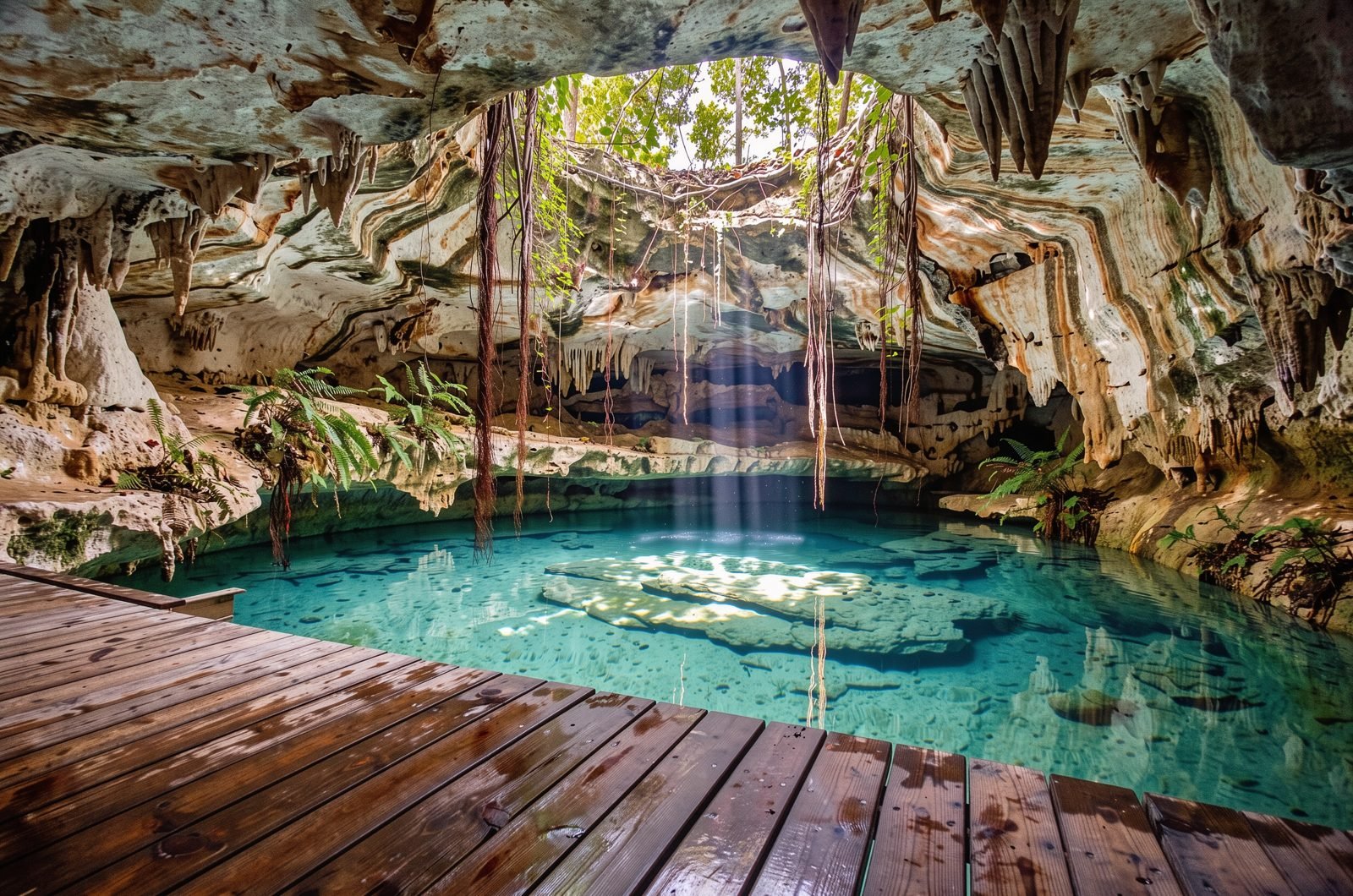
The Yucatán Peninsula combines white Caribbean beaches with Maya ruins, colonial towns and cenotes: natural sinkholes filled with crystal clear fresh water. It is the most visited part of Mexico and, thanks to the Tren Maya and good roads, easy to explore.
Cancún


Cancún has the busiest international airport in the region and a 22 km Hotel Zone with all-inclusive resorts between the Caribbean and the Nichupté lagoon. The beaches in the north, such as Playa Gaviotas and Playa Langosta, have calmer water. Take the ferry to Isla Mujeres for a relaxed day, or go snorkelling at the underwater sculpture museum MUSA.
Playa del Carmen

About 45 minutes south of Cancún, Playa del Carmen is livelier and more walkable, with Quinta Avenida as its pedestrian heart. It is a good base for day trips to cenotes, the eco parks Xcaret and Xel-Há, and the ferry to Cozumel.

Cozumel

Mexico’s largest Caribbean island lies on the Mesoamerican Reef, the second largest barrier reef in the world. The visibility is often more than 30 metres, which makes Cozumel one of the best places in the world for scuba diving and snorkelling. Use reef-safe sunscreen.
Tulum

Tulum is known for its Maya ruins on a cliff above the sea, its bohemian beach hotels and its cenotes. The ruins and the beaches now lie within Parque del Jaguar; arrive at opening time to avoid the heat and the tour buses. Tulum also has its own international airport, with a Tren Maya station. Further south, the Lagoon of Seven Colours at Bacalar is well worth a detour.
Riviera Maya

The Riviera Maya is the 130 km coastline between Puerto Morelos and Tulum, with quiet bays such as Akumal, where you can snorkel with sea turtles, and some of the best resorts in Mexico. The most beautiful cenotes, such as Dos Ojos, Gran Cenote and Cenote Azul, lie just inland.
Chichén Itzá

Chichén Itzá is the most famous Maya site and one of the New Seven Wonders of the World. The El Castillo pyramid, dedicated to the feathered serpent Kukulcán, is built as a calendar: at the spring and autumn equinoxes the shadow on its staircase looks like a snake sliding down. Climbing has not been allowed since 2008. Go early, combine the visit with the colonial town of Valladolid and the Ik Kil cenote, or take the Tren Maya to the Chichén Itzá station.
Mérida

The capital of Yucatán is a relaxed colonial city with pastel-coloured mansions along Paseo de Montejo, lively squares with free music and dance in the evening, and excellent Yucatecan food. It is a good base for the Ruta Puuc with Uxmal, for flamingos at Celestún and for the many cenotes around Homún.

Oaxaca and Palenque
Oaxaca

For many travellers Oaxaca is the highlight of Mexico: a colonial city full of galleries, markets, mezcal bars and some of the best food in the country. Do not miss the church of Santo Domingo, the hilltop Zapotec city of Monte Albán, the petrified waterfalls of Hierve el Agua and the craft villages in the valleys. Oaxaca is also one of the best places to experience the Day of the Dead.
Palenque

In the jungle of Chiapas lies Palenque, perhaps the most atmospheric Maya site, with temples rising between the trees and the sound of howler monkeys. The Temple of the Inscriptions holds the tomb of the king Pakal. Palenque is the western terminus of the Tren Maya and can be combined with the waterfalls of Misol-Ha and Agua Azul, though for San Cristóbal de las Casas and the rest of Chiapas check the latest travel advice first.
Guadalajara, San Miguel de Allende and Monterrey
Guadalajara

Mexico’s second city is the home of mariachi, tequila and the jarabe tapatío. See the cathedral with its yellow towers, the Orozco murals in the Hospicio Cabañas (a UNESCO World Heritage site), and the artisan district of Tlaquepaque. The town of Tequila and the agave landscape are an easy day trip.
San Miguel de Allende

This colonial town in the highlands of Guanajuato is famous for the pink neo-Gothic Parroquia church, cobbled streets, art galleries and rooftop bars. Combine it with the silver city of Guanajuato, about an hour and a half away.
Monterrey

The industrial capital of the north lies dramatically between mountains, with the saddle-shaped Cerro de la Silla as its symbol. Walk the Paseo Santa Lucía riverwalk and the Macroplaza, and go hiking or climbing in the Parque Ecológico Chipinque and the Huasteca canyon. The north is famous for cabrito (roast kid) and carne asada.
Puerto Vallarta and the Pacific coast
Puerto Vallarta

Puerto Vallarta on the Bay of Banderas combines an old town with cobbled streets, a long seafront promenade (the Malecón) and beaches backed by green mountains. From December to March humpback whales come into the bay. Quieter beaches and fishing villages such as Yelapa, Sayulita and San Pancho lie nearby. Other Pacific highlights are Los Cabos at the tip of Baja California and the surf beaches of Oaxaca, such as Puerto Escondido and Mazunte.
Where to stay in Mexico
- Four Seasons Hotel Mexico City: a classic luxury hotel on Paseo de la Reforma with a quiet courtyard garden, close to Chapultepec Park.
- Hotel Carlota, Mexico City: a stylish design hotel with a pool courtyard in the Juárez neighbourhood, walking distance from Roma.
- Casa Oaxaca, Oaxaca: a small boutique hotel in a colonial house in the centre, a few blocks from Santo Domingo.
- Rosewood San Miguel de Allende: colonial-style luxury with a rooftop bar overlooking the Parroquia.
- Chablé Yucatán, near Mérida: a restored hacienda in the jungle with private pool villas and a spa around a cenote.
- Nomade Tulum: a bohemian beach hotel with a focus on wellness and yoga.
- Rosewood Mayakoba, Riviera Maya: suites with private plunge pools along lagoons and a quiet stretch of beach.
- Hotel Esencia, Xpu-Ha: a former private estate on one of the most beautiful beaches between Playa del Carmen and Tulum.
Compare prices: check current rates for hotels in Mexico City, hotels in Cancún and hotels in Playa del Carmen on Booking.com.
Mexico itinerary ideas
- 10 days, Yucatán loop: 3 days Playa del Carmen or Tulum with cenotes, 1 day Bacalar, 2 days Valladolid and Chichén Itzá, 3 days Mérida with Uxmal and Celestún, then back to Cancún by Tren Maya or car.
- 2 weeks, culture and coast: 4 days Mexico City with Teotihuacán, 4 days Oaxaca, then fly to Cancún for 6 days on the Riviera Maya with a day at Chichén Itzá.
- 2 weeks, the colonial heart: 4 days Mexico City, 3 days San Miguel de Allende and Guanajuato, 3 days Guadalajara with Tequila, and 4 days on the beach in Puerto Vallarta.
Practical Mexico travel tips
- Do not drink tap water; bottled or filtered water is cheap and available everywhere. Ice in restaurants is usually made from purified water.
- Mexico City lies at 2,240 metres: take it easy on your first day and drink plenty of water.
- Learn a few words of Spanish; a friendly “buenos días” and “gracias” make a big difference.
- Many cenotes and marine parks require you to shower before swimming and ban regular sunscreen; bring a reef-safe one.
- Toilets often have a bin for paper, as the plumbing cannot handle it.
- Download Uber or DiDi and an offline map, and get a local SIM or eSIM (Telcel has the best coverage).
- Travel insurance with medical cover is strongly recommended; private hospitals are good but expensive.
Book your trip to Mexico
A few services we find useful when planning a trip to Mexico:
- Tickets and tours: skip-the-line tickets and tours in Mexico City on Tiqets
- Car rental: compare rental cars on Economybookings.com
- Mobile data: an eSIM for Mexico from Airalo, so you are online as soon as you land
Some links in this section are affiliate links. If you book through them, CountryDiscover may earn a small commission at no extra cost to you.
Conclusion
Mexico is big enough for a lifetime of trips: the pyramids of Teotihuacán and Chichén Itzá, the food of Mexico City and Oaxaca, the cenotes and beaches of the Yucatán and the colonial towns of the highlands. Pick one or two regions, travel in the dry season, and you will want to come back.
Planning a longer trip through Latin America? Read our guides to Guatemala, Belize, Cuba, Costa Rica, Colombia and Peru, or explore every country on our interactive world map.