
Norway
Explore Norway: A Complete Travel Guide
Norway is a country of dramatic nature: deep fjords framed by waterfalls, Arctic islands with jagged peaks, glaciers, the midnight sun in summer and the northern lights in winter. Its cities are compact and easy to explore, from the modern waterfront of Oslo to the colourful wharf of Bergen and the Arctic capital of Tromsø. Norway is expensive, but with good planning it is one of the most rewarding destinations in Europe. This guide covers when to go, entry rules, getting around, costs, culture, the top places to visit, food and where to stay.
Norway travel guide: the essentials
- Capital: Oslo. Other major cities are Bergen, Trondheim, Stavanger and Tromsø.
- Currency: Norwegian krone (NOK). Norway is almost cashless; cards and mobile payments work everywhere.
- Language: Norwegian; almost everyone speaks excellent English.
- Entry: Norway is not in the EU but is part of the Schengen Area.
- Electricity: 230 V with type C and F plugs.
- Best for: fjords, hiking, road trips, the northern lights, the midnight sun, coastal voyages and design.

Contents
- Best time to visit Norway
- Entry rules
- Getting around Norway
- Travel costs in 2026
- Safety and outdoor tips
- Culture and traditions
- Top places to visit
- Norway’s cities
- Norwegian food and where to eat
- Where to stay
- Itinerary ideas
- Practical tips
Best time to visit Norway
- Summer (June to August): the best time for the fjords, hiking and road trips. Days are long, and above the Arctic Circle the sun does not set from late May to late July. This is also the busiest and most expensive season.
- Spring and early autumn (May and September): fewer visitors and lower prices. Some mountain roads, such as the Trollstigen, only open in late May or June.
- Winter (November to March): the season for the northern lights in Tromsø, the Lofoten Islands and Finnmark, plus skiing, dog sledding and snowy cities. Daylight is very short in the north.
Entry rules
- EU and EEA citizens: can enter with a valid passport or national ID card.
- Visitors from outside Europe: the normal Schengen rules apply: many nationalities, including US, UK, Canadian and Australian citizens, can stay up to 90 days in any 180-day period without a visa.
- EES: non-EU travellers have their fingerprints and a facial image registered at the Schengen border under the Entry/Exit System, which has been fully operational since April 2026.
- ETIAS: the planned European travel authorisation for visa-exempt visitors is not yet in operation, and the EU has not announced a final start date. No action is needed until it does.
- Duty-free limits: Norway has strict limits on alcohol and tobacco, also for travellers from the EU.
Getting around Norway
- By train: Vy operates scenic lines such as Oslo to Bergen and the Flåm Railway. The “Norway in a Nutshell” route combines train, fjord cruise and bus in one day.
- By coastal ship: Hurtigruten and Havila sail the coast between Bergen and Kirkenes, calling at dozens of ports along the way.
- By car: the best way to explore the fjords and the National Tourist Routes. Roads are good but narrow and winding; allow plenty of time, and expect tolls and ferry fares. Most road tolls are registered automatically by camera.
- By plane: domestic flights save a lot of time for long distances, for example from Oslo to Tromsø or the Lofoten Islands.
- Ferries: car ferries cross most fjords and run frequently; no booking is needed for most routes.
Travel costs in 2026
Norway is one of the most expensive countries in Europe, especially for eating out and alcohol.
- Accommodation: a hostel bed costs about NOK 400 to 600, a mid-range hotel NOK 1,500 to 2,500 a night, and a cabin or rorbu in Lofoten often NOK 1,500 or more.
- Food: a main course in a restaurant costs NOK 300 to 450; a beer in a bar around NOK 120. Supermarkets and bakeries keep costs down.
- Tourist tax: Norway has no nationwide tourist tax, but municipalities under heavy tourist pressure may charge up to 3% on overnight stays. Tromsø, Vågan in Lofoten and Stranda, which includes Geiranger, have had their plans approved; collection starts in 2027 at the earliest.
- Daily budget: plan on about €100 to €140 per person a day for budget travel and €200 to €300 for mid-range travel.
Safety and outdoor tips
Norway is one of the safest countries in the world. The main risks come from nature: weather in the mountains can change quickly, so check the forecast and conditions on yr.no and varsom.no before hiking, take warm clothing and follow the mountain code. In winter, roads can be icy and some mountain passes close or are only open in convoy. Emergency numbers are 112 (police), 113 (ambulance) and 110 (fire).
Culture and traditions
Norwegians value nature, equality and the outdoor lifestyle known as friluftsliv. The right to roam (allemannsretten) lets everyone hike and camp in uncultivated land, as long as you respect nature and keep your distance from houses. On 17 May, Constitution Day, people across the country celebrate in bunad, the traditional costume, with parades and flags.


Top places to visit in Norway
The Geirangerfjord and Nærøyfjord
The two UNESCO-listed fjords are the highlights of western Norway. Take a fjord cruise past waterfalls such as the Seven Sisters and drive the Trollstigen and Eagle Road.

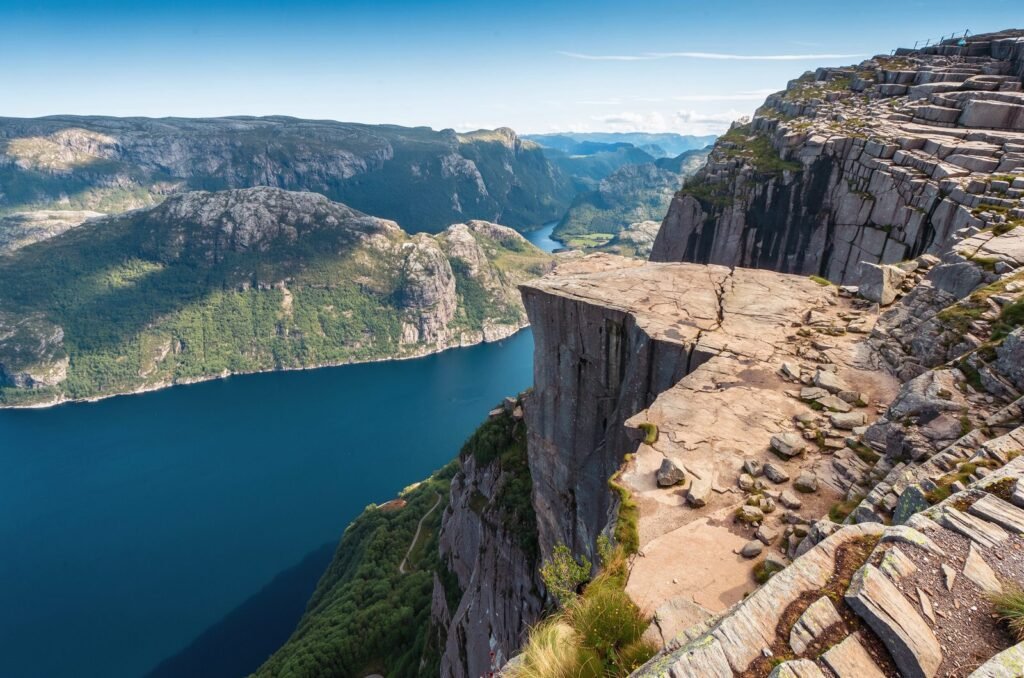
Preikestolen (Pulpit Rock)
A flat cliff 604 metres above the Lysefjord near Stavanger, reached by a hike of about two hours each way.
The Lofoten Islands
Fishing villages with red rorbuer cabins, white beaches and peaks rising straight from the sea, connected by bridges along the E10. Beautiful in summer and in the northern lights season.


The northern lights
From late September to late March, the aurora can be seen on clear, dark nights above the Arctic Circle. Tromsø, Lofoten, Senja and Alta are popular bases, and many tours drive out of town to find clear skies.

The Flåm Railway and Norway in a Nutshell
One of the steepest standard-gauge railways in the world descends from the mountains to the Aurlandsfjord, combined with a cruise on the Nærøyfjord.
Norway’s cities
Oslo
The capital is built around its fjord, with the Opera House, the new Munch Museum, the National Museum, Vigeland Sculpture Park and the Viking ships of the Museum of the Viking Age.

Bergen
The gateway to the fjords, with the colourful wooden Bryggen wharf (UNESCO), the fish market and the funicular up Mount Fløyen.

Tromsø
The largest city in northern Norway, known for the Arctic Cathedral, the cable car up Storsteinen and northern lights trips.

Stavanger and Trondheim
Stavanger has a charming old town of white wooden houses and is the base for Preikestolen. Trondheim, the old Viking capital, is home to the Nidaros Cathedral and the colourful wharves of Bakklandet.


Ålesund, Fredrikstad and Lillehammer
Ålesund is famous for its Art Nouveau architecture, Fredrikstad for its star-shaped fortified old town and Lillehammer for skiing and its Olympic heritage.


Norwegian food and where to eat
Norwegian cuisine is built on excellent local ingredients: salmon, cod, king crab and shrimp from the sea, lamb and reindeer from the mountains, and berries in summer. Try smoked salmon, creamy fish soup, fårikål (lamb and cabbage stew), brown cheese (brunost) on waffles and, in winter, dried cod (klippfisk).


Recommended restaurants
- Maaemo, Oslo: three Michelin stars and a tasting menu based on Norwegian nature.
- Baltazar, Oslo: Italian cooking with a celebrated wine cellar.
- Bare, Bergen: Michelin-starred Nordic cuisine.
- Bryggeloftet & Stuene, Bergen: traditional Norwegian dishes on the Bryggen wharf.
- Fagn, Trondheim: modern Norwegian cuisine with a Michelin star.
Where to stay
From design hotels and historic fjord hotels to cabins and rorbuer, Norway has distinctive places to stay. Book early for summer.
- The Thief, Oslo: a design hotel on the waterfront at Tjuvholmen.
- Hotel Ullensvang, Hardangerfjord: a family-run hotel right on the fjord.
- Hotel Union Øye, Sunnmøre: a historic hotel in the Hjørundfjord, visited by kings and writers.
- Hotel Union Geiranger: views over the Geirangerfjord.
- Reine Rorbuer, Lofoten: traditional fishermen’s cabins in one of Norway’s most beautiful villages.
- Brekkeseter, Rondane: a mountain lodge for hikers and skiers.
Compare prices: check current rates for hotels in Oslo, hotels in Bergen and hotels in Tromsø on Booking.com.
Itinerary ideas
- Five days, Oslo and the fjords: Oslo (2 days), Norway in a Nutshell to Flåm, then Bergen (2 days).
- Ten days, fjord road trip: Bergen, the Hardangerfjord, Flåm, the Sognefjord, Geiranger, Trollstigen and Ålesund.
- One week, Arctic winter: Tromsø (northern lights, dog sledding) and the Lofoten Islands.
- One week, summer in the north: fly to Bodø, take the ferry to Lofoten and drive the islands, then continue to Senja and Tromsø.
Practical tips
- Book accommodation and rental cars early for June to August.
- Download the Vy, Entur and yr.no apps for trains, public transport and weather.
- Buy alcohol at the Vinmonopolet shops; supermarkets only sell beer, and not late in the evening.
- Bring layers and a waterproof jacket, even in summer.
- Tap water is excellent: bring a refillable bottle.
- Respect the right to roam: take your rubbish with you and keep away from private homes.
Book your trip to Norway
A few services we find useful when planning a trip to Norway:
- Car rental: compare rental cars for a fjord road trip on Economybookings.com
- Mobile data: an eSIM for Norway from Airalo, so you are online as soon as you land
Some links in this section are affiliate links. If you book through them, CountryDiscover may earn a small commission at no extra cost to you.
Conclusion
Norway rewards travellers who love nature: fjords, mountains, Arctic islands and the northern lights, combined with clean, safe and welcoming cities. Choose summer for road trips and hiking or winter for the aurora, plan your budget carefully and book the popular spots early. For more inspiration, read our guides to the United Kingdom, Italy and Japan.